Why RTX Spark PCs Could Be the Biggest Change to AI Workstations Since CUDA
Published: 6-4-2026
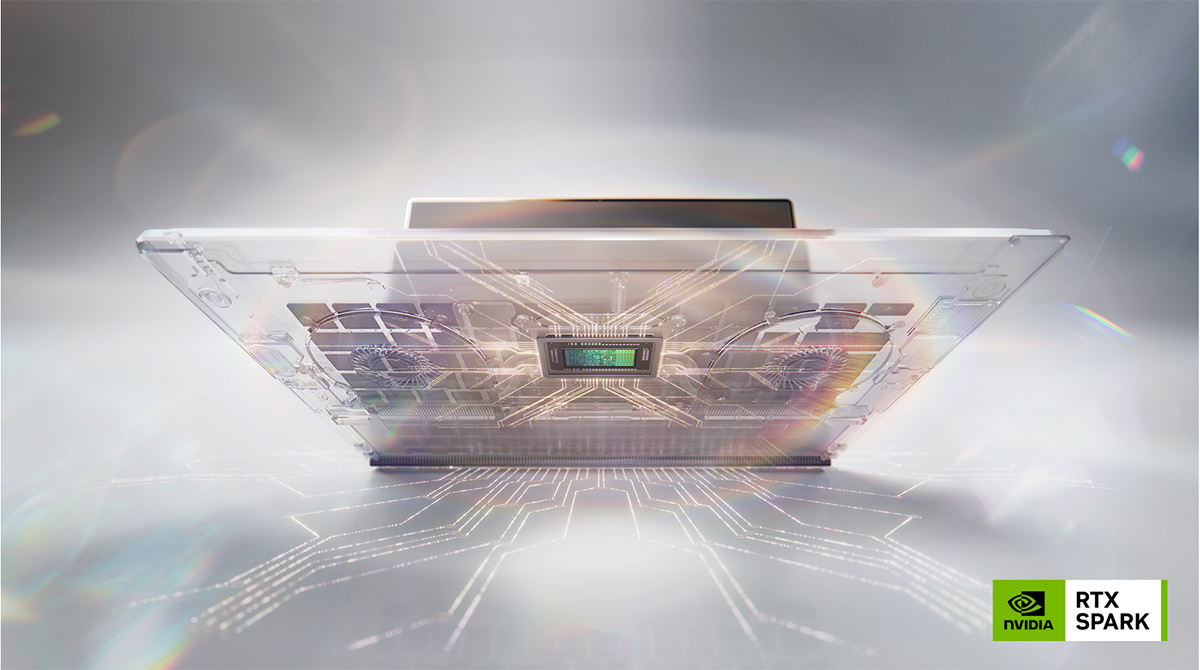
Image Credit: NVIDIA
There have been a few attempts to reinvent the PC over the years, but NVIDIA and Microsoft aren’t even being coy about it. In an NVIDIA press release it literally uses the word “reinvent,” so there’s no ambiguity about what they’re trying to do.
The question is of course what implications this has for those of us who are currently using PCs to get our work done. It’s never a comfortable situation when the ecosystem you rely on changes in dramatic ways, but despite all the fanfare things might not be set to change as quickly as NVIDIA and Microsoft’s marketing might suggest.
Playing catch-up with Apple
Let’s be honest here, the RTX Spark “superchip” is really just NVIDIA trying to do what Apple’s already done with Apple Silicon. The big green chip giant probably took note that Apple Macs with big memory allocations were suddenly very popular for those who wanted to run local AI models.
You could buy a MacBook or Mac Mini with oodles of RAM to fit large models, run your AI tasks overnight, and then still use all your macOS apps during the day. The big key here was that unified memory. Because Windows PCs generally have physically separate RAM and VRAM pools, you’re quite limited when it comes to model size. It doesn’t matter if you have a super-powerful RTX 5090, but you can’t fit your model into its 32GB VRAM allocation.
Macs are also power-efficient, and don’t lose performance when you unplug them. NVIDIA has made all the same claims when it comes to laptops that run with a Spark chip inside. All-day battery, no performance loss when on battery power, and great thermals to boot.
NVIDIA, like Apple, is using Arm CPUs alongside its own GPU technology, but it remains to be seen how performant those CPUs are, since Windows’ track record with Arm is less than stellar.
But what about software?
Which brings us to the much more important issue of software compatibility. MacOS has Rosetta II, and Windows for Arm has Prism. Both promise to translate x86 code so that it can run on Arm CPUs, but Rosetta is so much better at it. At least so far.
The promises from NVIDIA sound good. Jensen Huang stood on stage and confidently declared that all of the software we currently use on Windows will run on RTX Spark. Every CUDA workstation app, every regular Windows app, and even video games.
They can go on about NVLink bandwidth and unified memory as much as they like, if the software runs poorly or not at all, it’s for nothing. We think it’s pretty clear that Spark will succeed or fail based on its ability to seamlessly run the software of today with no loss of performance.
It’s about more than laptops
We sell many fine mobile workstations, ranging from relatively thin-and-light systems to hefty desktop-replacement workstation laptops. Having performant thin-and-light machines like RTX Spark promises to bring is exciting, and it would certainly have a place assuming the software issues have been resolved.
However, NVIDIA also announced desktop systems. Some would be Mac Mini-like and others would come in a full desktop form factor. That’s interesting, because Apple has famously canceled the Mac Pro, because the nature of Apple Silicon makes the large desktop chassis pointless.
However, Apple Silicon doesn’t support GPU expansion. The GPU you get is the one you have to use. We assume that adding a second or a third GPU to a Spark desktop won’t be an issue. But there are still many questions about system building and customization with Spark desktops that will have to be answered going ahead.
We might be looking at a situation where you can’t upgrade the RAM on your workstation, because it’s integrated in an SoC, or that you’ll use a powerful expansion GPU for one application, while the Spark GPU with its larger VRAM count does the AI work. Particularly, NVIDIA wants us to run AI agents, and Microsoft has openly said that Windows will become an agentic AI OS. So that explains how Spark and Windows go together.
Speaking of Windows, we still need to see if Linux can run on Spark, since so many of you, our valued customers, don’t use Windows on your workstations at all. It’s early days, but we’ll be watching the progress of RTX Spark with great interest.
|
|
|

